


How To Test Adhesive Tape Quality Before Mass Production
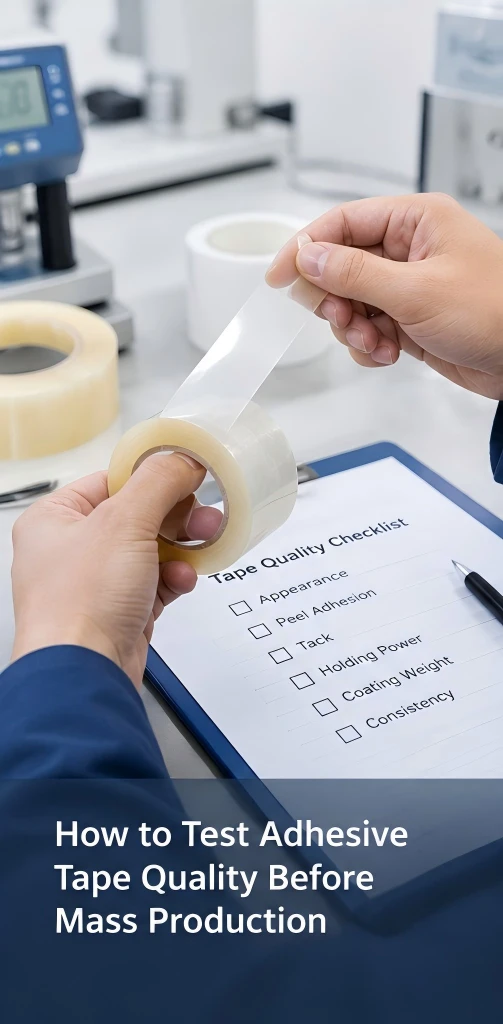
Learn how to check adhesive tape quality before mass production, from coating appearance and adhesion tests to trial runs and production consistency.
A new adhesive tape sample may look good, stick well, and pass an initial test. But will it perform the same way after several thousand meters have been produced? That is a different question.
For tape manufacturers, moving from a laboratory sample to mass production is often where hidden problems begin to appear. Adhesion may vary, the coating may become uneven across the web, or the finished rolls may not perform consistently. Finding these problems early is much easier than dealing with a large batch of rejected products.
Before starting mass production, it is worth checking both the finished tape and the process used to make it.
Start with the problems the tape needs to solve
There is no single test that works for every adhesive tape. Packaging tape needs reliable bonding during use, while masking tape may also need to come off cleanly without leaving residue. Medical and industrial tapes can have their own application-specific requirements.
Before testing, clarify what the customer expects from the finished product. This determines which properties need to be measured and what counts as an acceptable result.
Don't rely on appearance alone
Look closely at the coated sample. Streaks, pinholes, bubbles, uncovered areas, and visible contamination can indicate problems with the coating process or the materials.
It is also useful to compare samples taken from different positions across the web. If the middle looks different from the edges, the issue may not be obvious when inspecting only a small piece.
However, a smooth adhesive layer does not necessarily mean the tape will perform well. Adhesion needs to be tested separately.
Check how the tape behaves after application
Peel adhesion is one of the common measurements used for pressure-sensitive adhesive tape. It indicates the force required to remove the tape from a specified surface under defined conditions.
Initial tack and holding power provide different information. Tack relates to how readily the adhesive forms a bond on contact, while holding power evaluates its ability to resist movement under a specified load over time.
These properties should not be judged by feel alone. Use an agreed test method, keep the conditions consistent, and compare the results with the product specification. ASTM D3330 and ASTM D6195 are examples of standards used for peel adhesion and loop tack testing, respectively.
A higher test result is not automatically better. The tape must perform as required for its intended use.
Check the coating process, too
If adhesion results vary between samples, adding more adhesive may not be the right solution. First, check whether the coating weight is consistent and whether the substrate and adhesive materials are suitable for the application.
Differences in coating conditions, material properties, or web handling can affect the finished tape. Recording the relevant production settings alongside the test results helps narrow down the cause.
Run a production trial before approving the product
A short sample run may not reveal problems that develop over time. During a longer trial, watch for changes in coating appearance, web tracking, and winding quality. Take samples from different stages of the run rather than relying on one piece collected at startup.
Once the product meets the agreed requirements, record the material details, process settings, and test results. These records give the production team a useful reference for repeat orders.
For manufacturers investing in an adhesive tape coating machine, this information also helps clarify what the equipment needs to achieve. Howie Machinery can discuss coating requirements based on the adhesive, substrate, target coating weight, working width, and intended application.
If you'd like to learn more or discuss customization options, feel free to contact us!


